Olympia. The City-State known for being the closest to the abode of the gods, Mount Olympus.
It was built here a long time ago, when it was still believed that due to its proximity to the great sacred mountain, they would be protected by the gods.
Today, this is no longer believed, and the city, once a point of worship in particular, is now just one of many polis. Perhaps a visiting point for eccentric priests and pilgrims.
A huge city surrounded by a stone wall stood on the vast plain, surrounded by a few farms that lay among the forestless fields.
This night seemed peaceful, and the beautiful sky highlighted the brightness of the constellations in contrast to the absolute darkness of the universe. Few clouds, no noise. The Milky Way, Hercules' masterpiece, decorated the firmament for star admirers to enjoy once again.
The city guard walked among the mansions of the upper and noble part, the Acropolis, while a brave few defied the curfew and wandered through the city's alleys. A few other guards gathered at the walls.
On top of one of the posts on the large walls, two guards enjoyed the night breeze in a relaxed manner. An apparently seventeen-year-old recruit, and an older guard in his early forties.
— Yeah, it looks like we won't have anything to do again today — the young man had his chin resting on his hand and his gaze lost in the stars.
— May the gods hear you, boy — replied the older guard sharply, without taking his attention away from a piece of wood he was carving with a sharp knife.
— Do you really believe them, Argus? — the boy turned to him, surprised.
— It's just a way of talking — replied the old man. — A plague that we get from our parents.
The young man sighed, a little disappointed.
— My grandfather swore he saw a Cyclops near Nemea once. He told me stories of heroes and monsters...
— And the only monster I saw this month was the Archon tax collector — old Argus cut roughly and forced the knife into the wood. — Believe me, Adonis, the gods are too busy to care about us. Let them exist, let them not exist, fuck them if you want to know.
The young man faced the sky again, his shoulders were heavy with boredom. The sergeant's reaction was the most common. The heroes' great stories were now just that: stories.
Lost in the stars, Adonis blinked, his eyes caught something strange. A beam of light cut through the night sky at a speed greater than any meteor. He narrowed his eyes and saw, even from a distance, the beam change direction, rising to the clouds and defying gravity. His eyes widened.
— SIR-SIR! LOOK! IT'S THE MESSENGER! It's HERMES! — pointed to the golden trail with an enthusiasm he hadn't felt in a long time.
— Stop the nonsense and be quiet — Argus grumbled, not bothering to look.
— No, seriously! You need to see it! Look! Look!
Desperate to prove his belief, he ran and grabbed the old man's shoulders, and pulled him. The sudden movement made the man's knife slide, opening a cut in his hand.
— Argh! His one-— son Argus stood up with a grimace of pain.
The old man roared and threw a punch with a fury that made up for the strength lost by age. The fist found Adonis' plexus protected by a leather breastplate, and threw him against the wall railing.
— I DON'T WANT TO KNOW ABOUT DEAD GODS! — shouted his face red with anger. — If you have so much time to look at the sky, then grab a mop and go clean the latrine! AND DON'T COME BACK UNTIL YOU LEAVE IT SHINING!
— Y-yes, sir! I am really sorry! — The boy got up awkwardly and ran to the stairs.
The sergeant watched him disappear between grumbles and looked for a cloth to stop the cut. When he turned around, he felt a current of wind pass through him, a shiver ran down his spine. He turned around, scared.
There was nothing. Just the same quiet, starry sky.
— Rum. Hermes. Tch! — He grumbled mockingly, sitting back down.
Far from the wall, the golden trail cut across the night sky. For the few mortals who saw it, it was a shooting star, an omen. For him, it was just the way home.
Hermes, the god of messengers, ran through the air with lightness and elegance. The wind fluttered his white clothes violently.
Below, the world of men was a dark carpet, dotted with the dim lights of bonfires and distant cities. From that altitude, he saw trade routes like glowing veins in the earth, felt the changes in pressure in the air that heralded storms days away. It was his job, but also his fun.
In his right hand, the Caduceus rested, inert. The left, empty, was open and moving quickly, following the movement of his legs like a figure.
He accelerated, the golden trail became longer in the sky. Zeus's summons echoed in his mind. “Urgent”. It was a word his father didn't use lightly.
He didn't usually worry, however, there was a disturbing silence around the call. He had delivered the message to everyone, from Ares in his training camps to Aphrodite in her temple. None of them knew why. Not even Poseidon, his uncle, whose knowledge of the depths rivaled that of the heavens.
This bothered him. Hermes was the god of secrets, of information that flowed between worlds, of enlightenment, but this time he was in the dark.
His mind traveled to the last time he felt that same tension in the air of Olympus. The Titanomachy was ancient history, but the war against Typhon was a recent scar. He still remembered the terror in the eyes of the other gods, the exasperated fury of Zeus, the sight of the colossus whose head touched the stars. He remembered the smell of chaos.
Tonight's air had a hint of that same smell.
Absorbed in his dark thoughts, it took him a while to notice the familiar glow of Mount Olympus approaching. With a surprising ability to control, he stopped without slowing down, and landed softly on top of the hill, in the center of a huge marble altar and black stones marked by ancient runes. The wind was blowing at the top, cold and rarefied.
The night whistled at him, but he didn't respond. For a being made of movement, stillness was a form of torture. He hung the Caduceus around his waist and clasped his hands together, closing his eyes. It was forbidden to go up to Olympus uninvited, but it was not forbidden to rush the host.
Suddenly, the sky, once clear, responded. Lightning struck, violently, and enveloped his body in a blinding light. There was a bang that echoed through the mountains, and when the smoke cleared, the altar was empty.
Above Mount Olympus, on a floating island, resides Olympus. The abode of the gods.
Coliseums, large buildings, amphitheaters, accommodation, training camps and even huge gardens. White marble shines upon Selune's blessings, more than any torch beneath the clouds, more than any precious stone within the seas.
Here lives royalty. The royalty of the Gods.
Below a huge arch carved perfectly in marble, Hermes appeared silently. He adjusted his tunic like an actor preparing to enter the stage, composed his face and forced the crease of concern to transform into his usual smile, the mask of irreverence that everyone expected from him.
In the next instant, he noticed a figure meters ahead, sitting at the broken base of a pillar, playing a lyre with his back to him.
A boy with blond hair that reached his neck and an athletic and slender build. It was Apollo. The melody that floated in the air was a low, melancholic song, which in a few moments let out dissonant notes that were unusual in the compositions of the God of Music.
Hermes approached in silence with a riddled brow and placed his hand gently on the strings of the lyre, muffling the sad sound.
Apollo was startled, turning around with wide golden eyes. Upon seeing his brother, his expression changed to tense relief. He sighed.
— Hermes...
— What a funereal melody, brother — said Hermes with a slutty smile that didn't fully reach his eyes. — Did someone die and forgot to tell me?
— Not today, Hermes. Please — Apollo replied in a low, worried voice. — The air is heavy. I feel something wrong.
— Wrong? — Hermes raised an eyebrow, taking the lyre from the hand of an Apollo too surprised to react. — You've always been the most dramatic of us. What ails you? Did the father finally ban his mediocre poems?
He held the lyre as if he were going to touch it in a provocative gesture to force a genuine reaction.
— It's no joke! — Apollo stood up in anguish — No one knows the reason for the meeting. Nobody. Not even Athena. My father... he's different. There's a fury about him that I haven't felt since the war against the Titans. And you arrive late, as always.
— He's right to worry. And you, if you had a little sense, would worry too. — Before Hermes could retort, a third voice, cold and graceful as the marble at his feet, cut through the air.
The two turned around. Hera was standing there, her purple eyes assessing them with obvious disgust. His presence was imposing, and the atmosphere, which was already tense, became icy.
— He-Hera... — Apollo stammered, tilting his head in a gesture of respect.
Hermes, in turn, offered a charming smile that contrasted with the chill he felt when he saw her.
— It's great to have you with us, stepmother. Always radiant.
Hera clicked her tongue.
— Hurry up. Their father is waiting for them. And he is not in the mood for your insolence.
He turned and walked away, his tunic slid silently like a serpent's tail.
Apollo turned to Hermes in a panic.
— See? I told you. Something very serious is about to happen.
Hermes returned the lyre to his brother and his smile finally disappeared. His half-closed eyes looked thoughtful. He patted Apollo on the shoulder.
— So we better not keep him waiting any longer — the lightness in his voice now sounded forced even to himself.
Unlike other meetings, marked by conversations and music, this one seemed dominated by a heavy and oppressive silence. The gods stood still like statues in their designated places.
All eyes were fixed on the marble thrones in the center, the tension was palpable. On the left was the empty throne of Hades, on the right sat Poseidon, the god of the seas, whose restless fingers clashed rhythmically against the stem of his trident. Her black hair, already splashed with gray, fell over her shoulders and her deep blue eyes showed impatience. The large scar that crossed his chest seemed to contract with every second of waiting.
Hera, with her long black hair and sharp purple eyes, remained standing next to the central throne, her hand resting on her husband's shoulder.
Hermes entered the golden hall, and felt the weight of dozens of divine gazes upon him. He and Apollo took their places on the side, and an even deeper silence settled in.
Zeus stood up. His figure was imposing, his long white beard fell on a strong, defined chest. His eyes, without pupils, swept the assembly.
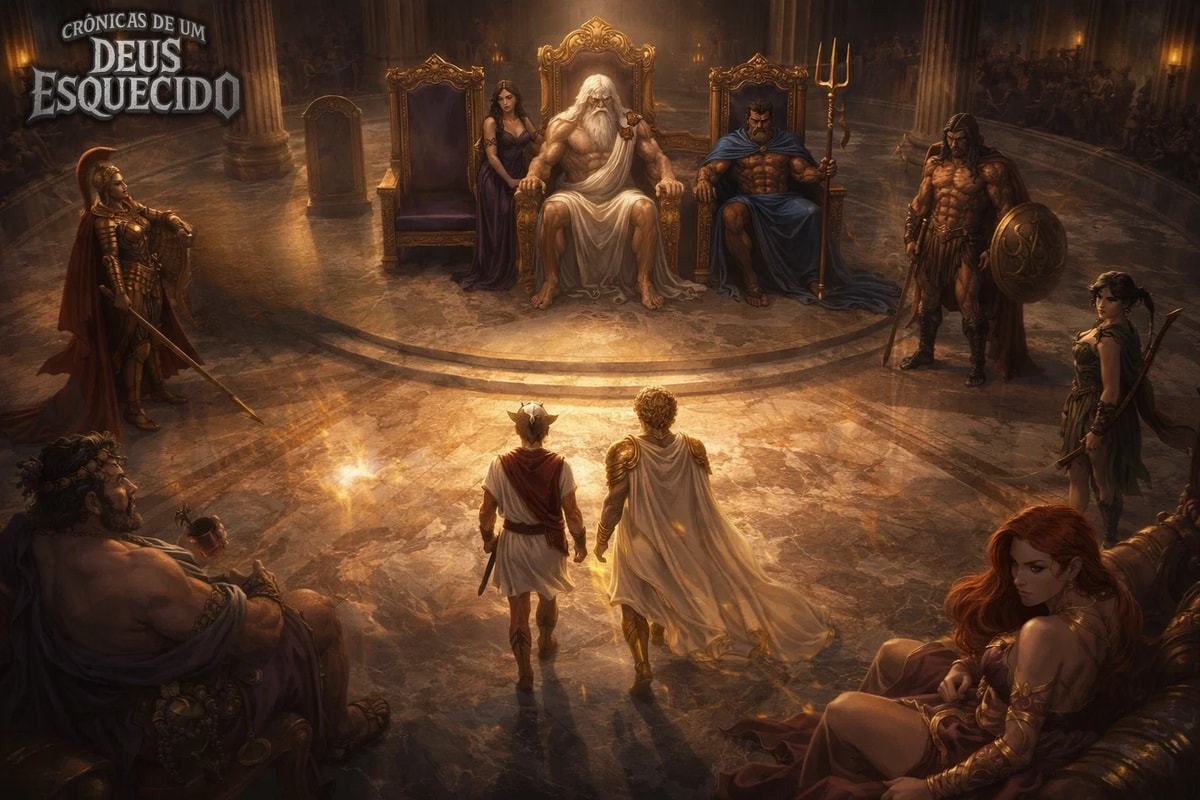
— I called you here to deal with the mortal world. — the voice resounded in the hall, deep, ancient — The faith of men, the source of our influence, diminishes every day.
— This conversation again... — Poseidon grumbled, letting impatience overcome prudence.
Zeus pretended not to hear, and continued.
— Humanity forgets us, but make no mistake. Their faith does not disappear by chance. She's being... corroded.
He paused so that the weight of his words settled down.
— I feel an energy that I haven't felt since the war against Typhon. An unholy energy, from Tartarus himself, has leaked into the world of mortals.
Murmurs of shock and disbelief filled the room.
— Impossible! — cried Poseidon, rising from his throne. — The gates of Tartarus are sealed! Hades guards them. — He stated his arm raised toward his brother's empty throne.
— It's not an escape, Uncle. It's a fissure. An influence — Athena's voice sounded, calm and analytical. Standing, with his shield at his side and his spear firmly in his hand, his brown eyes seemed to dissect the air itself, seeking logic in the crisis. — Someone, or something, is creating a bridge.
— Then we must smash this bridge before anything else crosses it! — growled Ares.
The god of war, whose red eyes burned with the promise of violence, stepped forward, his long red hair swaying over his scarred chest.
⁇ — What mischief... — a wet, muffled laugh came from a corner.
Dionysus, pot-bellied and with a flushed face, raised his glass of wine, a crown of dark grapes hanging over his hair. — Maybe they were never fully tied up...
Apollo, pale, ignored the drunkard's comment and turned to his father. — Who would dare act against Olympus, father? Who would betray us?
Zeus's half-closed white gaze swept the lobby.
— An oracle brought me a warning. A fragment of an ancient, almost forgotten prophecy. — as if pronouncing profanity, he whispered. — She says: “The armageddon note will announce its arrival when the herald finally has his last message sent.”
Artemis whispered something to herself with an uncomfortable face, the white strand of her short black hair fell a little over her eyes. Aphrodite twirled a strand of her red hair with her fingers, her green eyes were tense.
Afraid, Apollo almost swallowed the question that stuck in his throat.
— B-but who? Which herald? — whispered the musician.
The god of lightning closed his eyes for an instant. Then, he gritted his teeth, and with his eyes open, cold and heavy, he said:
— A herald — shouted. — One who travels freely between kingdoms. One who knows the secrets of Olympus and the underworld. One who could, under the guise of his craft, deliver a message to our chained enemies, opening the fissure that threatens us.
The silence that followed was absolute. All eyes turned to Hermes, the white chiton god with elegant features. Apollo stared at him, his mouth half-open in horror.
— Hermes is the traitor! — Thunder slid with the king's fury from a cloud-clear sky.
Hermes, the target of the entire pantheon, met his father's furious gaze. And, to everyone's complete astonishment, he smiled.
A smile that contained no joy, but the jocular disbelief that he had actually heard that.